
Although there is headroom for further monetary policy action, at this juncture it is important to keep our arsenal dry and use it judiciously: RBI's Das.

Foreign investors have made a strong comeback to Indian equities with a net investment of Rs 22,766 crore in the first two weeks of December driven by expectations of rate cut by the US Federal Reserve. This revival follows significant outflows in the preceding months, with Foreign Portfolio Investors (FPIs) pulling out a net Rs 21,612 crore in November and a massive Rs 94,017 crore in October -- the worst monthly outflow on record.

As deputy governor, Patel headed the RBI panel to draft the monetary policy report, which became the basis of the ongoing reforms at the apex bank

Net foreign direct investment (FDI) in India, inflows minus outflows, declined sharply in April-August this year to $2.99 billion from $18.03 billion in the same period last year on moderation in global activities and a rise in repatriation. The Reserve Bank of India's data (October 2023 bulletin) said FDI in India was $7.28 billion and FDI by India, that is money invested abroad from the country, was $4.28 billion in April-August 2023. As for 2022, FDI in India was $22.79 billion and FDI by India was $4.76 billion in April-August.
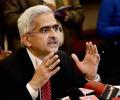
The uncertainty created by the jump in COVID-19 infections and localised lockdowns prompted RBI Governor Shaktikanta Das and other members of the rating setting panel MPC to unanimously vote for status quo in interest rates and an accommodative policy stance to support growth, as per minutes of the meeting released on Thursday. "The need of the hour is to effectively secure the economic recovery underway so that it becomes broad-based and durable," the Governor said during the three-day meeting of the Monetary Policy Committee (MPC) which ended on April 7. The renewed jump in COVID-19 infections in several parts of the country and the associated localised and regional lockdowns add uncertainty to the growth outlook, he observed, as per the minutes of the meeting released by the central bank.

A combination of factors, including heavy investments in US Treasury bonds and dollar sales at a healthy profit, facilitated the Indian central bank in transferring a record surplus of Rs 2.11 trillion to the government for 2023-24 (FY24). The RBI's dollar purchases increased in FY24, supported by robust capital inflows endorsing the economy's health.

The economic growth is likely to moderate to 6.1 per cent, slowest in over seven quarters, from 6.6 per cent last year same period.

Calls for decisive fiscal policy action to revive growth

Stuart A Davis, the chief executive officer at HSBC India, expects the Reserve Bank of India to increase repo and reverse repo rates by 25 basis points in its quarterly monetary policy review on July 27, as concerns over accelerating inflation and uncertain monsoon linger.
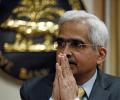
The RBI's rate-setting panel MPC on Monday began its three-day deliberation amid expectations of another round of hike in benchmark interest rates to contain inflation that continues to remain above the central bank's upper tolerance level. RBI Governor Shaktikanta Das will announce the decision of the Monetary Policy Committee after deliberations on Wednesday. Das has already indicated that there may another hike in the repo rate, though he refrained from quantifying it.
In the last three years, public sector banks have responded to the RBI's policy rates more strongly than private banks.

The MPC headed by RBI Governor Urjit Patel said that the recent excise duty cut by the government on petrol and diesel will help contain inflation.

Growth is coming from sectors which are interest rate-sensitive, says D Subbarao.

The RBI interest rate decision, industrial production data for June and the ongoing quarterly earnings from corporates would largely drive the stock markets this week, analysts said. Other major factors such as global market trends, the movement of oil prices and the trading activity of foreign investors would also influence trading, they added. "The market will have an eye on the RBI Monetary Policy Committee (MPC) meeting, which will be announced on August 10, 2023. We are heading towards the last batch of Q2 earnings of key companies such as Adani Ports, Coal India, Hero MotoCorp, Hindalco and ONGC, among others, which will lead to stock-specific movement," said Pravesh Gour, senior technical analyst, Swastika Investmart Ltd.

Observing that there is liquidity overhand of Rs 13 lakh crore in the system, RBI Governor Shaktikanta Das said on Friday that the exceptional measures undertaken during pandemic will be dealt in sync with macroeconomic developments to preserve financial stability. Since the onset of the pandemic, the Reserve Bank has maintained ample surplus liquidity to support a speedy and durable economic recovery, he said while announcing the outcome of the Monetary Policy Committee (MPC) meeting. The level of surplus liquidity in the banking system increased further during September 2021, with absorption under fixed rate reverse repo, variable rate reverse repo (VRRR) of 14 days and fine-tuning operations under the liquidity adjustment facility (LAF) averaging Rs 9 lakh crore per day as against Rs 7 lakh crore during June to August 2021, he said.

Hinting at some tightening of the monetary policy on Friday, the Reserve Bank on Thursday said inflation is a major challenge and would address it without hurting the growth.

'The real repo rate is very high in terms of core inflation.'
The Reserve Bank of India (RBI) is precariously balancing two opposing objectives - maintaining easy financial condition in the domestic market, while ensuring external stability - and economists have started taking note. They say India is going through the classic trilemma of the 'Impossible Trinity'. The RBI cannot have an independent monetary policy (setting domestic interest rates) in an environment of an open capital account and flexible exchange rates. What is even more complicated for the central bank now is that financial market stability overlays all the other three objectives.

Referring to the proposed new monetary policy framework, it said in the weeks ahead, government and RBI will work towards it.

The Reserve Bank on Friday projected retail inflation to be in 5-5.2 per cent range during the first half of the next fiscal year, expecting further softening of vegetables prices in near term. Also, it has lowered the retail inflation forecast for the current January-March quarter of 2020-21 fiscal at 5.2 per cent. The Reserve Bank (RBI) has kept the key policy rate unchanged at 4 per cent, with an accommodative stance, so as to ensure that inflation remains well within the target, Governor Shaktikanta Das said while announcing the last monetary policy of 2020-21.

Tomorrow's review could also turn out be the last policy anchored by Rajan if the proposed Monetary Policy Committee (MPC) is put in place before the next review due on August 9.
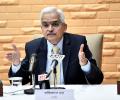
The Reserve Bank of India (RBI) on Wednesday raised the benchmark lending rate by 35 basis points to 6.25 per cent in a bid to tame inflation, which has remained above its tolerance level for the past 11 months. With the latest hike, the repo rate or the short-term lending rate at which banks borrow from the central bank now has crossed 6 per cent. This is the fifth consecutive rate hike after a 40 basis points increase in May and 50 basis points hike each in June, August and September.
The RBI is not statutorily independent from the government but has long enjoyed wide latitude

RBI Governor Shaktikanta Das has assured Finance Minister Nirmala Sitharaman that the Rs 12.05-trillion gross borrowing programme for FY22 will go through smoothly.

The government on Monday said inflation continues to remain a concern, but exuded confidence that the RBI's monetary policy will lead to moderation in inflation numbers in the coming months.

From the 30-share pack, Adani Port, Bharti Airtel, Asian Paints, IndusInd Bank, Bajaj Finserv, Reliance Industries, Infosys, UltraTech Cement, HDFC Bank, HCL Technologies and ICICI Bank were among the laggards. Tata Motors, Axis Bank, Maruti, Larsen & Toubro, ITC and Tata Steel were among the gainers.

SBI was the top gainer in the Sensex pack, spurting over 2 per cent, followed by ICICI Bank, Nestle India, IndusInd Bank, M&M, Bajaj Auto and Maruti. NSE Nifty advanced 135.55 points to 14,819.05.

Select bankers will meet RBI Deputy Governor Subir Gokarn, who is in-charge of the monetary policy department, and other central bank officials on July 12.

The fifth meeting of Monetary Policy Committee maintained the repo rate, at which it lends to the banks, at 6.25 per cent and the reverse repo, at which it borrows, will be 6 per cent.

RBI has pegged the GVA growth of 7.6 per cent for the current fiscal and 7.9 per cent the year after
The declining inflation and a negative industrial outlook have strengthened the case for RBI.

Retail inflation rose to three-month high of 4.81 per cent in June, mainly on account of hardening prices of food, according to the government data. Inflation based on the Consumer Price Index (CPI) stood at 4.31 per per (revised upward from 4.25 per cent) in May and 7 per cent in June 2022. The inflation, however, remains within the RBI's comfort level of below 6 per cent.

Prospects of a bumper kharif harvest are expected to lower food inflation in the coming months, making the country's inflation outlook benign, the Union Ministry of Finance (FinMin) said in its monthly economic report for October released on Monday.
In its macroeconomic review report, the RBI has cut FY13 GDP growth forecast to 5.7% vs 6.5%.

After raising interest rate by a cumulative 250 basis points in 11 months, the Reserve Bank of India (RBI) on Thursday unexpectedly kept benchmark rate unchanged as global banking woes added uncertainty to the economic outlook. Five out of six members of MPC voted to remain focused on the withdrawal of accommodation to ensure inflation aligns with target while focusing on growth, RBI Governor Shaktikanta Das said on Thursday. The Monetary Policy Committee of the central bank decided to take a pause after a rate hike seen in previous six consecutive policies.
'Three external members of the first MPC are respected researchers with excellent academic background, but there is no harm in considering academicians with diverse backgrounds such as finance and labour along with economists for this body,' recommends Tamal Bandyopadhyay.
More steps are necessary to accelerate speed.
The Reserve Bank of India on Tuesday left all the key interest rates unchanged in the first quarterly review of the monetary policy.

The unions are opposing the government's move to take away the public debt management from the Reserve Bank and curtail its powers on the monetary policy.

All-out efforts are needed to mitigate the adverse impact of the Covid-19 pandemic, and the RBI will use any instrument necessary to revive growth and preserve financial stability, according to the minutes of the central bank's policy meeting.
